Wednesday, November 19, 2008

1920- 1930

The Culture of Consumption

In the years after the First World War Europe is restoring, North America is going though economical rise. As a result of the growing produce and competition, increase the need of advertising. This sphere came to be very attractive for many of the new artists. The new talents and ideas were used in the war for the consumers attention bringing the advertising to the new level. The using (and abusing) of the visual is developed to sophisticated manipulation. Images suggest certain values, style and desires to the consumers. To accomplish this purposes the advertising resorts to some of the elements of the avant-garde.

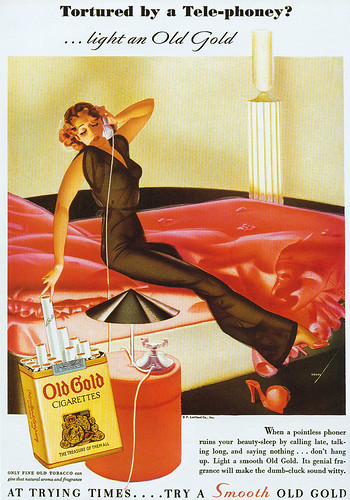


Avant-garde in the context of mass consumption
After the WWI many of the intellectual capacity of the Old Continent escape to North America searching for a better future, bringing with itself the new art movements created in Europe. Thus Constructivism, Futurism, Dadaism were found to be in the circumstances of quickly developing economic that needs well developed advertisement. Responding to that need some of the stylistic features of the avant-garde movements are quickly assimilated and commersialased. This new styles become a mark for modernity.


Professions
At that time many artist come together and create professional organizations. This institutionalization correspond to the new stage of the arts application.
1917 - Association of the American Advertising Agencies regulate advertising and provides more than 80% of the national advertises.
1919 - Bauhaus - art organization developed in Germany and later moved to USA
1920 - Art Directory Club is founded by Louis Pedlar and it is the first international organization of this kind.
Magazines


Consumer Engineering
The new philosophy of the manufacture is twisted. Instead of creating a product for peoples needs, there are created needs for the new products.
Using the archetype images and visual codes the artists create recipes for what you must be, look, like, want.


Branding, psychology, market analyzes - advertisement became the perfect form formanipulation.


Fonts
Art Deco search for "geometric beauty" and fonts related with it are sans-serif.
Here are one of the most common Art Deco font types.


References
http://nwalsh.com/comp.fonts/FAQ/cf_28.htm#SEC98
Graphic Design History A critical Guide

Monday, November 17, 2008

1910 - 1930

Innovation and Persuasion

As logical continuation of the Decadence, Aestheticism and mechanization of the working process come Abstraction, Futurism and Dadaism. Those are one of the main styles that define Classical modernity.
Dehumanization, machine aesthetics, geometric forms, fracture of the shapes are the next stages of the Late Nineteenth Century Cynicism. The World War I enhance this spirits. The war brings nonsense, destruction and confusion.


Visual culture and avant-gadre.
It seems like in times of trouble people tend to be more extreme in taste. The social background of the Twentieth Century and the growing role of the machines come as a challenge to the artists to experiment using the new technologies. Their experiments are respond to the reality as well as distillation of it.
The term avant-garde is french and literally means "advance guard". In military this word denote "a small troop of highly skilled soldiers, explores the terrain ahead of a large advancing army and plots a course for the army to follow" (Wikipedia). In cultural filed it means those who push the limits of the norms and possibilities.


Wassily Kandinsky
He is Russian artist, avangardist and theorist whose art is expressive and strongly abstract. Points, lines, colors- he rely on psychological effect created by the basic elements.


Technical capabilities and Experiments
The new styles often use photography and photo montage, printing technology, typography but breaking the rules.

Futurism
Is international movement, but it center is in Italy. The beginning is set with the "Futurists manifesto" by Filippo Marinetti. As the name suggests this is movement turned to the future. This movement reveals the beauty of the machine and the aesthetic of the pure geometric forms.


Dada

Dadaism begins in Zurich. The World War I was not only political event. For the people who live in it the war has social and moral dimensions. Its absurd evokes the relevant reaction.
Shocking destruction of the forms, broken, confusing - DADA is impossible to be understand.


What is DADA?

Playing with the sense, or actually going beyond of the sense Dadaism is a protest against the war and is so absurd as the war itself.


Constructivism
As in the nature everything is seeking for balance, processes in the art also follow the same low.
In the late Nineteenth Century Aesthetic principle "art for the art's sake" isolate the art from reality. This extremeness soon is compensated by Constructivism. This style is a result of the post war sobering up and utilitarian tendencies in Russian Futurism. It could be characterized with sanserif type font, primary colors, abstract geometric shapes.


Propaganda and Graphic persuasion
Many of the artist at that time were engaged in creating propaganda images. Because the avant-garde was too far from the mainstream sensibility those deviant art were rarely approved for propaganda. For mass persuasion much more successful was Plakatstil (poster style) which borrowed the flat colors of the Art Nouveau, but was not so complicated.


Bauhaus
One of the most famous modern styles that influence the graphic design, typography, architecture. It's slogan is "the new unity of art and technology". It start as a school and soon become a movement which consider the machine as new tool. For me this style embodies the same coldness as the Futurism and Constructivism.


It seems like modernism leaves strong mark over the communist countries (although later it is mixed with the heroic realism). I was 10 years old when Communism fell and I remember how boring was for a child all those clear shapes, row colors and sterile designs. Everything was the same - mostly blue and red, with no details, made fast and cold.
I also remember that in the first few years after 1989 a common kid collection was pack of import goodies - they were so colorful, well illustrated and definitely very different from what we were use to see.


This is the design of my favorite shampoo and a cover of plate with faritale.


Saving cream


References:
http://en.wikipedia.org/wiki/Avant-garde
http://www.krugosvet.ru/articles/56/1005620/1005620a1.htm
http://z.arttoday.org/bauhaus/bauhaus.html
http://anneserdesign.com/Plakatstil.html

Friday, November 14, 2008

1880 - 1910

Chapter 8
Formations of the modern movement

This time is the border between romanticism and modernity. Time for experiments, exploring, and breaking the rules. Time that set the beauty as the ultimate sense of the art (and probably the life) and the same goes beyond it. The deifying turns in exhaustion.

Historical events:
1896 Olympic games revived in Athens.
1889 Vincent Van Gogh paint his self-portrait
1890 The Picture of Dorian Grey is published (Oscar Wilde)
1901 The radio is used as a device for messages.
1903 First airplane fly.
1905 The Paris Subway
1905 Vladimir Lenin support the Russian revolution.


Styles related with the period:
Art Neuveau:
An echo of the Victorian era and influenced by Art and Craft Movements. It is characterized by organic forms,
stylized floral ornaments, decorative, flowing curves, female forms, eroticism, rejection of realism.

Alphonse Mucha - Czechoslovakian who moved at Paris in 1890. He is one of the symbols of French Art Nouveau. After the WWI he returns in Czechoslovakia and start the Slavic Art and Crafts movement.


Ivan Bilibin - russian artist influenced by Art Nouveau. He is one of the emblematic artist for the Russian Folk Art Movement. His works illustrate folk tales.


William Morris
- Art and craft movement, well known with his fabric patterns, modernization of antique type fonts


Leopoldo Metlicovitz


Jugendstil:
the german equivalent of Art Nouveau

Gustav Klimt


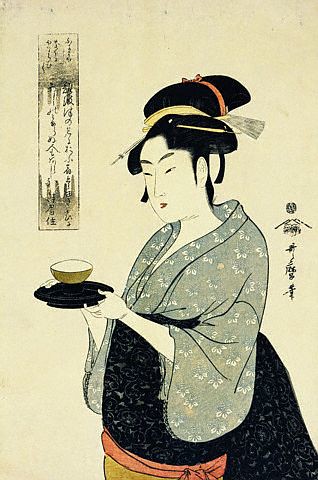
Ukiyo-e - "the floating world"
Japanese style of woodcuts and paintings. It depicts landscapes, historical events, scenes of pleasure. In fact many of Ukiyo-e works are advertisements
of tea houses, theaters, restaurants - places for pleasure.

Utamaro
"Teahouse waitress serving cup of tea"


Decadence and Aestheticism

One of the most debatable art movements. They both (as well the symbolism) has their roots in The Romanticism. They both escape from the reality.

Decadence as they say is "the dark side of Romanticism.
" (Karl Beckson) It shows the decay of the moral and opens taboos like death, depression, deviation.

Aestheticism set the beauty in the center. The sensuous pleasure become most important. Art for the art's sake. The beauty is in cult.

References:

http://www.fontcraft.com
http://www.ukiyo-e.se/
http://en.wikipedia.org/wiki/Art_Nouveau


Friday, October 31, 2008

1850 - 1900

Chapter 7
Mass Mediation

Charlie Chaplin - Mothern Times 19


Industrial Revolution - The term denote the process of unprecedented technological development facilitating manufacture in such dramatic way so it had a huge social effect.
As a result many things changed:
- the way of production- more easy
- the price of production
- the accessibility of consumption - (in near future the way of consumption- more careless)
- the urban architecture - building fabrics, smoking chimneys.
- the way of working - with machine, not on the field, new professions
- the family organization - children knows more than their fathers, broken traditions
- the place living - process of urbanization
- the communication - it is more easy than ever before, more news

This is a process that still continue.
We are so fascinated by the machines. This is part of man's desire to overcome his weakness
Better, stronger, faster, smarter...
This is a competition with our imagination- what we could be. A race that had no end.

How it Industrial Revolution affect on Graphic design?
- the war for attention - The increased manufacture create the need of advertising. There are created new fonts to answer the needs of
- the illustrations - first used to support graphically the written information, later to add romantic or comic feeling
- the photography - add new criteria for realism.
- the distinction between fine arts and art for trade
- the birth of ephemera - low cost, standard, mechanical production, not personal

Industrial Revolution and Graphic design in Bulgaria.
Although Bulgaria was under the Ottoman Rule until 1878 the process of industrialization also affect the country. The new liberated Bulgaria opens to Western Europe to catch up what she had lost. The social and cultural live, and technical development is strongly influenced by the West and especially by France.

Bulgarian currency
100 leva


Check for payment
1927


Certificate for baptism
1917


1800 - 1850

The Graphic effects of Industrial Production

Nineteenth century is a period of big changes in the manufacture processes.
The machine production muster up strength affecting over everything.
Along that in this period emerge an interesting style, named after The Queen Victoria.
She rule United Kingdom of Great Britain and Ireland.
The style could be characterized with rich ornaments, laces, flower decoration and sweetens.
It affect not only dresses, but also houses, furniture, hair dresses

And for those who like Jane Austin


Decoration- flowers, ribbons, swirls... the empty space is blasphemy.


Of course this beauty had an other side


Bulgaria will feel wind of this changes at the end of the 19 th century.

Book with health advices
Published in 1846